
AI and the Death of the Creator Economy?
Thanks to AI, everyone can be a creator these days. It has literally never been easier to create content. But that comes at a price. Let's investigate!


Sup! 👋
AI is everywhere in content right now, and creators are piling in.
You’ve seen the output.
The bad stuff: posts that look like someone pasted a chatbot conversation straight onto the page.
The middle stuff: technically fine, with all the personality stripped out.
And the really good stuff, where people spent a lot of time enhancing their writing and content through AI.
The tools have made everyone faster. The harder question is whether speed is doing creators any favors.
Push that further, and you land on something bigger: Is AI killing the creator economy?
I think it’s doing the opposite.
Today, I’m breaking down what’s happening between creators and AI, and why I think it’s making the creator economy stronger with a twist.
PS: If you enjoy this newsletter and believe your friends or family would too, a recommendation would be greatly appreciated!

You may have heard the term “creator economy” before, whether on social media, in the newspaper, or here on Substack, but do you actually know what it means?
I asked Claude (I know, ironic) to explain to me what the word “creator economy” means, and here is its answer:
The creator economy is the ecosystem of independent creators who build audiences directly on platforms like Substack, YouTube, and TikTok, and monetize through subscriptions, ads, and sponsorships instead of working through traditional publishers. It’s estimated to be north of $200 billion globally, though most of the revenue concentrates at the top.
Source: Claude
In layman’s terms, the creator economy is an ecosystem of independent operators who speak directly to their audience and get paid for it through proven monetization models.
And here’s the part that matters: most of these are tiny outfits. One person, two people, maybe ten at the absolute high end.
No newsroom. No editing desk. No layers of approval. Just the creator, their convictions, and whatever message they’re trying to get across.
So what do you do? You obviously start using tools to enhance your workflows, and there it is. That’s where AI comes in handy.
Source: Adobe
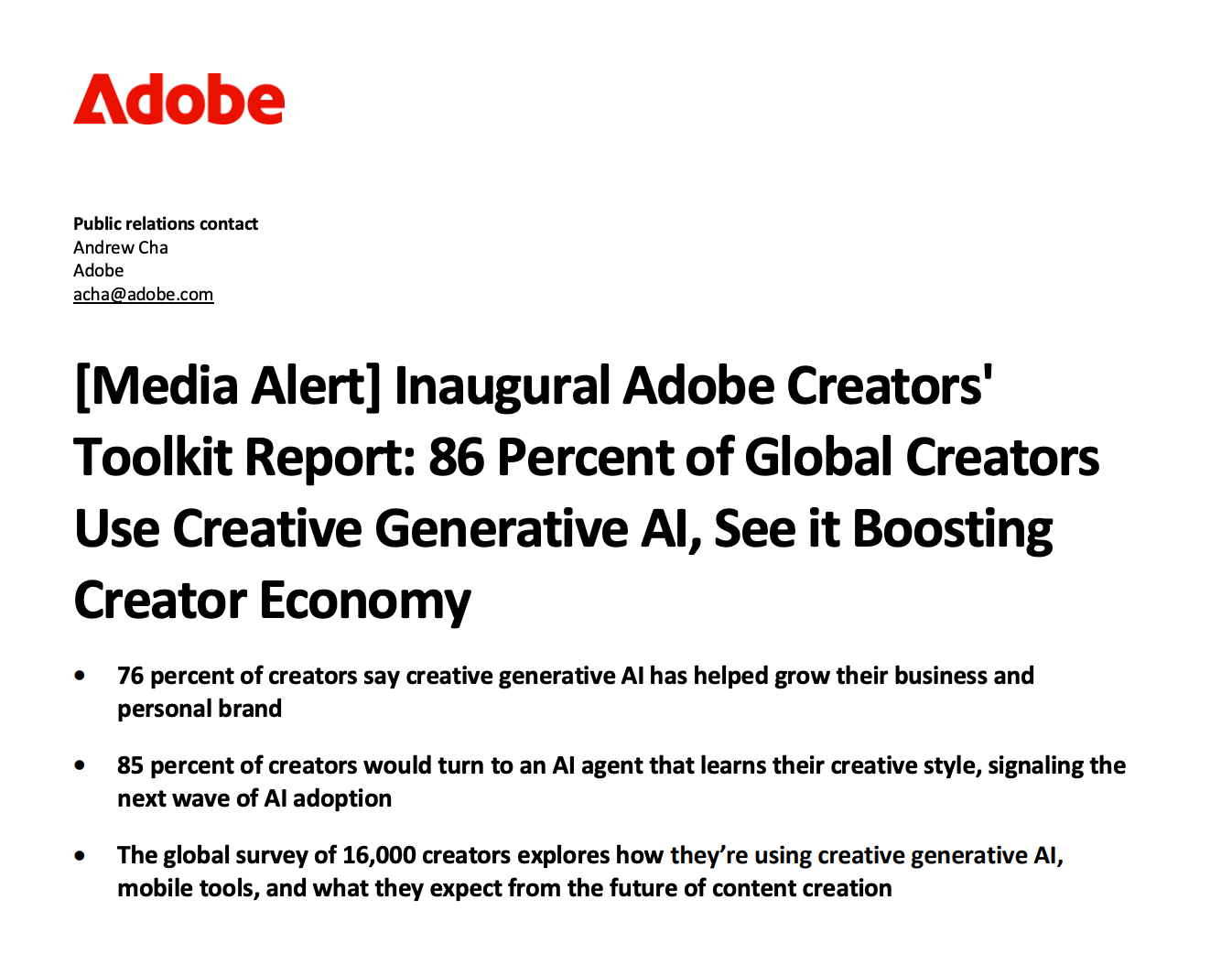
According to this study by Adobe, which I also double-checked with this article by TechCrunch, almost 85% of creators claim to use AI.
While the overall testing pool of just 16,000 creators is not synonymous with the entire world, there is a clear favor of creators, aka the creator economy, using AI.
The trend, though, is very clear. Creators are relying on AI to do the majority of their work.
And this is not just my view.
The inspiration for this piece came from an interview on New Economies with Ollie Forsyth.
Source: New Economies
He sat down with Tony Stubblebine, CEO of Medium, and the two of them got into it: what AI use actually means for creators, and whether any of those creators will ever see a cent from it.
Tony argues that the way readers find your content has completely changed.
Long gone are the days when you write something up, and people magically find you on Google.
Thanks to AI and the enhancements for creators, mainly to output content much faster, everyone is now publishing.
But in his words, this comes at a high price.
While creators use AI, most of these LLMs are using the content they produce to teach their models.
As creators pull their best work behind paywalls and private groups, the public internet fills with AI slop, degrading the very data these companies need.
He laid out a five-part playbook for creators to get around that:
Go private, either with paywalls or newsletters.
Lead with genuine expertise over volume.
Write evergreen content that works inside AI agents.
Use AI tools to unlock your own dormant expertise.
And let AI companies feel the pain of their own short-termism.
Which I find an intriguing angle.
Most creators, especially if you’re starting, are trying to outwork everyone.
Either by publishing more content, trying to exaggerate a trend, or by simply going the other direction.
You do all of that for free, with a “discovery-first” mentality in mind.
Tony argues that you need to go private much faster. Not to earn a quick buck, but to actually future-proof yourself against the dangers of big AI companies abusing your content.

Source: X
Which, honestly, is something I haven’t even considered when starting to write this article.
AI is hurting the creator economy. Not because creators aren’t getting paid, but because the content itself is collapsing.
You have likely seen the low quality of online content.
Everyone posting on LinkedIn sounds like a ChatGPT bot. X replies become robotic, and every newsletter looks the same.
To borrow a line from Les Misérables: even the darkest night will end, and the sun will rise.
We have to live through the slop phase before the good stuff separates from the noise.
AI has turned everyone into a production studio. That doesn’t change the fundamentals.
Content marketing still rewards those with something worth saying. Storytelling does most of that work. Use AI to sharpen the story. Not to skip writing it.
Storytelling can be a huge factor for this as well. Rather than using AI as a shortcut, prompt your copy or video script to deliver value.
This can be a simple prompt: “How would you rewrite this to get point A across?”
Or: “What would the ideal reader take away from this copy?”
Either AI gives you something usable and your content is sharper for it, or it doesn’t, and you’re back to the rewriting session editors have been running for centuries.
We’re in the early days of AI in the creator economy. People are testing. Creators especially. The ones who land on the workflows that sharpen their work are the ones who’ll pull ahead.
To sum it up: the creator economy isn’t dead because of AI. It’s running on steroids. And we’re figuring out which steroids work.
The creators who use AI to sharpen their work will be the ones standing out. The ones using it to fill space will not.
If you haven’t yet, block out a weekend. Teach your AI tool your writing style, your ideas, and what “better” actually looks like to you.
Once you see what it can do with that input, you won’t want to stop producing. The slop era ends when enough creators figure this out.
And the creator economy moves from $200 billion to $1 trillion. Faster than the analysts are forecasting.

I always get into a deep work writing block when I think about the creator economy. Hopefully, it wasn’t too much rambling.
But, as always, many other things were happening on the Internet, and I had to mention them as well!
Here are the Tabs Worth Opening:
Claude has a new product with a LoFi YouTube livestream: The team behind Claude can’t stop! They even vibe-coded a LoFi livestream for you to listen to while working. Check it out by clicking the title above.
GameStop’s CEO wants to buy eBay and they immediately blocked his account: This is the funniest story this week. GameStop CEO Ryan Cohen wants to buy eBay. There is even a weird CNBC interview with him in which he says the deal will be half cash, half stock. Nothing more. Then eBay responded by blocking his account.
James Murdoch wants to buy the New Yorker: You must be familiar with the Murdoch name. If not, watch the latest Netflix documentary about them. You’ll see that Succession was nothing compared to this family. Now, the outsider of the family, James, wants to buy the New Yorker. Fun times ahead…
Kalshi doubles its evaluation in five months: The prediction market platform Kalshi is at the brink of a new evaluation. The regulated rival to Polymarket is rumored to be worth $22 billion. That’s twice as much as five months before. Seems like people really like prediction casinos.
Johnny Haris’ recent interview with Semafor: I have been a Johnny Harris fan for a while now, and this week he was on the Semafor media podcast. In the 55-minute interview, he gave many insights into his content strategy and philosophy.

And that’s a wrap for the tenth full issue of Internet Native Capital.
The creator economy is one of the great compounding stories of the next decade. AI just made it compound faster.
The tools that used to belong to studios are in your laptop. The distribution that used to belong to networks is in your hands.
If you’ve been on the fence about starting something of your own, this is the moment.
See ya!
Thanks so much for the mention! Great piece!!
I think it's just the beginning 😁 brand, distribution & authority remain a constant