


Sup! 👋
Today’s piece is one close to my heart and something I have been thinking about for a while.
As a matter of fact, if I expand this topic to the age of AI and tech, I would say I have been thinking about it for over a decade.
For far too long, the media industry (at least the way I encounter it) has been monopolized, and it has never liked sharing.
Whether that was a piece of the subscription pie or the knowledge pie, the leaders in charge were strategic in not adopting emerging technologies too fast.
I believe there is a system behind this, and today is the day when I want to share my rants and thoughts with you.
So buckle in!
PS: If you enjoy this newsletter and believe your friends or family would too, a recommendation would be greatly appreciated!

I can still remember the moment I knew I wanted to work in the media industry.
Back then, I didn’t know it was called media or journalism yet.
But it was in the spring of 2006. I was ten years old, and I saw a video clip from one of the war-zone reporters.
He talked about the ins and outs of everyday life in such a unique way that I knew I wanted to do this.
So I ended up telling my parents that night that I wanted to work in the tele and write on paper.
Both of them encouraged me that this is great, but my skills in technology, tinkering, and figuring stuff out were probably just too good to ignore.
Looking back now, I realize that they encouraged me to go for bigger things, but hey, you don’t know this when you’re 10!
Nevertheless, I kinda listened to their advice and stuck my head down in school. Four years later, I had to choose my future at a jobs fair in school.
While others dreamed about becoming lawyers or doctors, I was still fascinated by being a media reporter, but this time with a twist.
Rather than reporting on dead bodies, I wanted to report on the Internet and technology.
This was the pinnacle of the mobile-first revolution, and as an ‘online kid,’ there wasn’t a feature, aka jailbreaking the iPhone you worked for the entire summer, that I didn’t want to try!
So I decided to do that and pursue economics as a backup.
And this is when I first got into the media landscape. I freelanced for some regional publishers and saw firsthand how bad they are with new tech.
Because I was the youngest one on the team, I had to cover events, startups, and social media.
For me, it was a no-brainer to use the newest technology to get my job done. From very early Machine Learning tools, to Grammarly, and some automation once a post was live.
But this didn’t sit well with my bosses. They didn’t acknowledge that I outpaced my colleagues.
“Son, you need to slow down and use the CRM the way it was intended to. No need to hook it up to all this fancy tech.”
That’s what I would usually hear.
And speaking of new tech, let’s fast-forward a few years to when I worked on a big paper. Still freelancing, I didn’t want to risk relying on only one media company, but I wanted to be a core part of the team.
What I saw there shocked me even more! This was in 2018, and the paper had just a simple back-end interface.
No common tech tools that let you find out more about how your content was performing.
No SEO strategy to outrank the competition for free. Just sitting there and thinking, very entitled, I may add, that people will find them.
The only things these media companies relied on were their brand equity and the fact that they have been around since 1902.
Which brings me to today. This lack of adoption of new tech has really come to bite big media publishers.

Source: X
Condé Nast CEO Roger Lynch was recently on the TBPN Podcast, where he said the company is no longer factoring Google into its plans.
This is known as Google Zero in the media industry, where big-time publishers no longer rely on Google for traffic.
What used to work before, where you would often write clickbait titles and throw anything at social media, doesn’t anymore.
They blame AI Overviews on Google and other LLMs for this.
Well, this is only one part of the story. The other part is a decade-long reluctance towards new technology and a lack of understanding of their own readers.
I remember sitting in a tube (for American readers, this is what they call the subway in the UK) in late 2018 and listening to Chris Best on a podcast.
He explained the ideas behind Substack and why they see a future where a new media would emerge.
Which is precisely what we have seen since 2020.
Long gone are the days when digital native readers would pay up to 30 bucks to hear the same stuff Reuters got you for free.
The modern crowd is not interested in hearing the same stuff again and again. Rather, they want close-to-heart reporting and the scoop in a language that doesn’t talk down to them.
Oh, and on that note, for the CEO of any big media company. AI Overviews are here, yes. But the underlying fundamentals of SEO still apply.
This is not me saying this, but Google itself in a blog post just a few months ago. They broke down how to prepare for the AI age.
Rather than complaining, how about setting up an SEO strategy that actually works and changing your outlook on this new moment in the industry?!
And get off your high horse, where you still believe that people read your articles because of your brand, and not because of the suggestion of a friend or family member.
Trust remains a key metric for readers, and this is where new media is simply better at building a closer relationship with its audience.
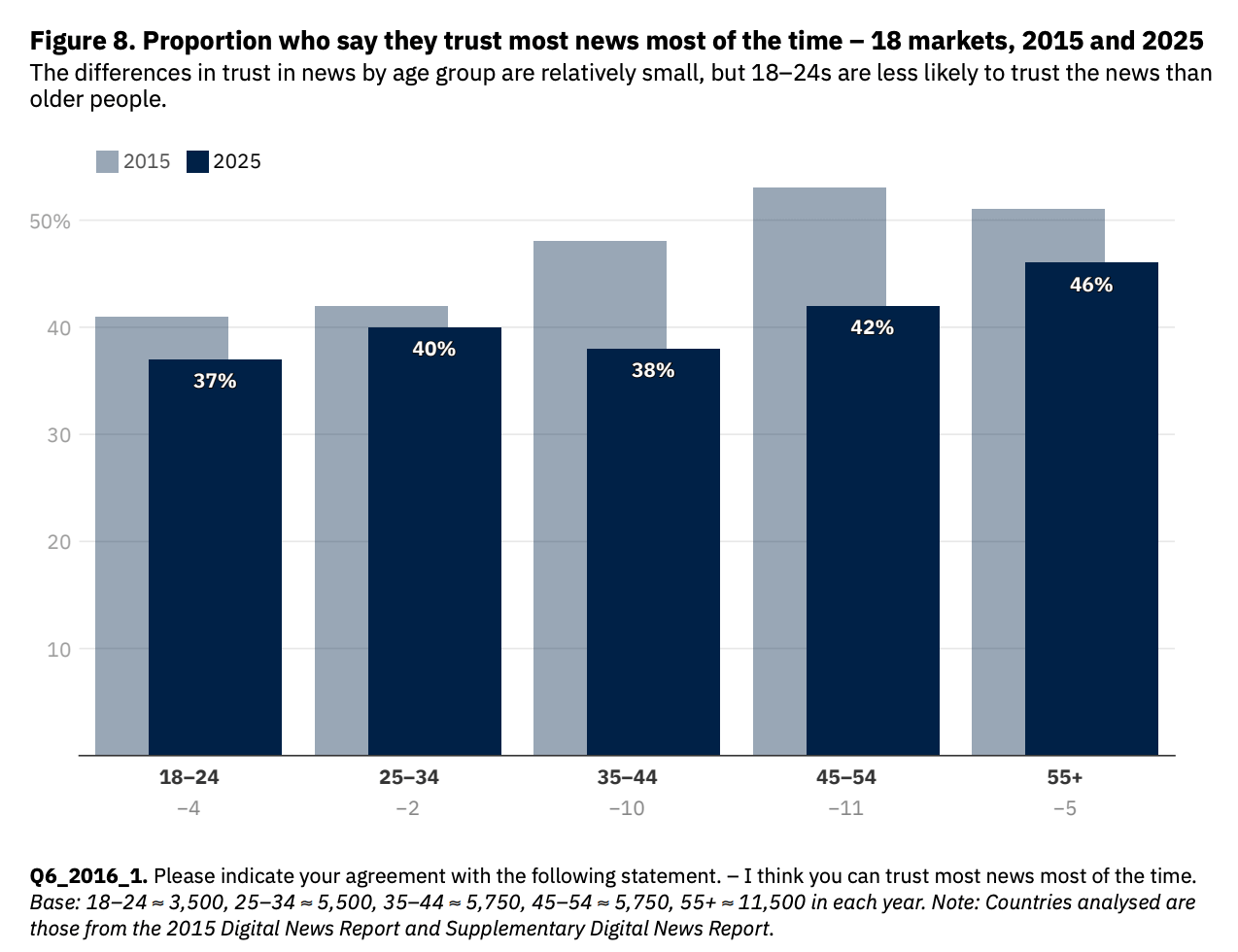
Source: Reuters Institute
But this is the key point with this topic. Do I believe the media industry will suddenly pivot and go all in on new tech? No.
Rather, they will try to add their own spin (I’m 99% certain that we will soon see in-house LLMs from media publishers), or they will buy the competition.
The good news, for those of us who publish on new media sites, is that readers will eventually find their way over to you.
It doesn’t matter if you use Substack, Beehiiv, or Ghost as your publishing machinery. All of these companies have new tech in mind and are already taking action.
Now, I don’t want to throw all the media outlets under the bus. The New York Times, for example, embraced the modern web quite late but is now one of the strongest outlets for online news.
While they were able to profit off their brand equity, they also pivoted to SEO-first principles, were early to get on the AI train, and embraced modern media strategies.
And this is the key point I want to address today. The AI era will revolutionize many things. It will produce a lot of slop. But it will also enable businesses to find their audiences in key decision moments.
So, the modern media landscape will be a mix of two tales:
One that embraces this tech and optimizes for it while still keeping the reader in mind.
And the other, which continues to block the adoption of a new interaction model and relies only on its brand.
I don’t bet, but if I did, I know on which of the two horses I would place a bet…

While the media industry is hurting, at least the ones that don’t act fast enough, there was also other news this week.
Here are the Tabs Worth Opening:
The UAE leads the global AI adoption race: A Microsoft study analyzed AI adoption by country. To my surprise, there are many countries in there that you would not expect to find. At the top of the list is the UAE. They were also among the first governments to announce service agents for the public sector by 2023.
Claude Opus 4.8 launched and is better at agentic coding: The team behind Claude can’t stop winning. It wasn’t even a month since they released Opus 4.7, and now they’re out with the latest model. While I have been using it for day-to-day stuff and haven’t noticed a drastic change, it apparently is better at coding.
Chris Best spoke about Substack’s future and AI: The CEO of Substack was on the Access podcast, a show I would recommend you big time, and he spoke about their vision for the future, how he deals with bad press, and when we can expect the Substack MCP.
Habity is your new alarm clock and a cute one as well: I think I never posted about products I like. This changes this week as I saw a very good-looking and thoughtful alarm clock from Denmark. My order is already placed. How can you now like this little buddy on your bedside table or desk for a Pomodoro work session?!
Aliens are here, according to the White House: This was really not on my bingo card. It’s 2026, and we’re seeing a website by the White House where they list and talk about alien encounters. Wild!

And that’s a wrap for issue number thirteen of Internet Native Capital.
It was more of a personal story with my love-hate relationship with big media outlets.
However, I hope I was able to show where this reluctant stance among big media publishers comes from and what the future of media will look like in the age of AI.
I hope you liked it, and as always, if you have any suggestions, ideas, or counter-talking points, use the comment section below.
See ya!
AI may change how people discover content, but trust, relevance, and a direct relationship with readers will remain the foundations of great media
I've actually been thinking about this and what it would mean to start opening up our own media or publishing companies. I don't think these big media gatekeepers getting less attention will be a bad thing for journalism because the good ones will adapt and know where to put themselves.